SolarINT Orchestrator
SolarINT Orchestrator packages CitizenSolar’s orchestration doctrine into a bounded product surface for pilot-ready storage deployments.
Software Product
SolarINT Orchestrator turns the doctrine into a productized control and evidence layer
Use this route to explain what SolarINT coordinates, what remains operator-supervised, and how the product fits storage-first pilot deployments.
Audience
Detail Focus
Scope Note
Review First
Product Next Move
Use this page when the doctrine needs to become a named product surface for technical diligence, pilot packaging, or partner enablement.
Jump To Section
Agent Modules
Product Overview
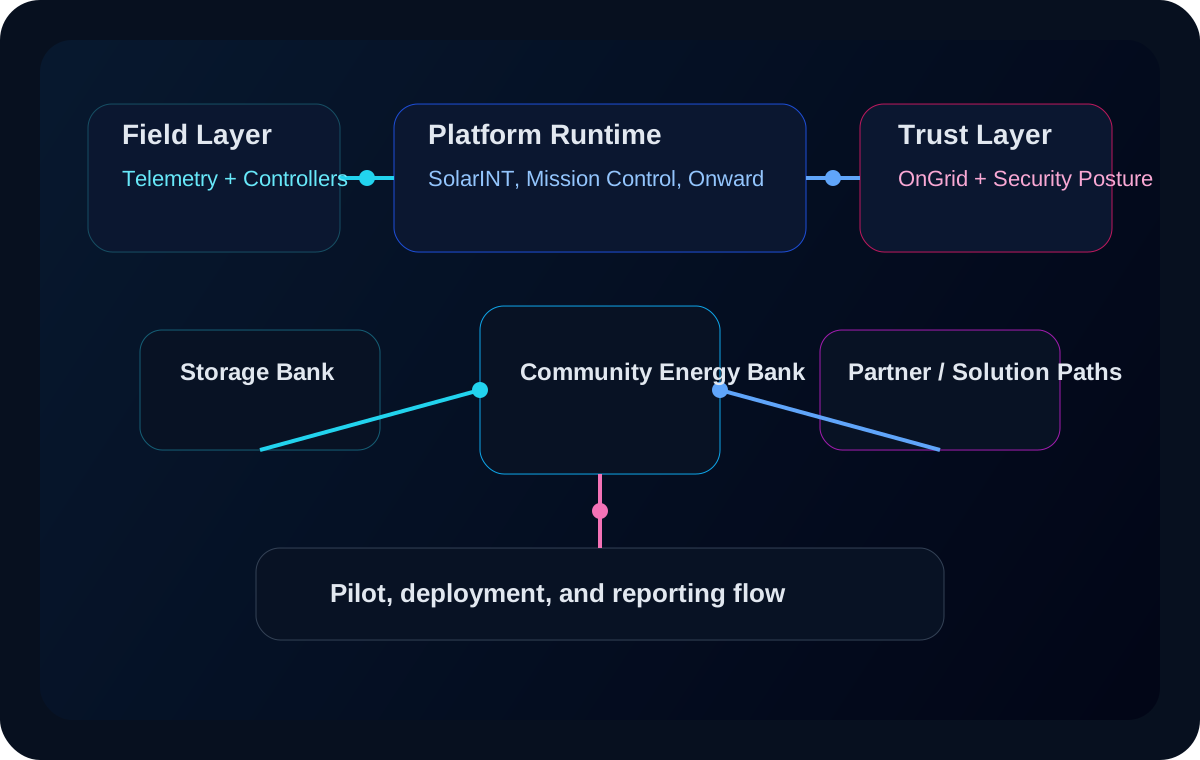
SolarINT Orchestrator is CitizenSolar’s deterministic orchestration layer for storage-first distributed energy systems.
- • Coordinates telemetry, reserve policy, BYOS assets, operator workflows, supplier-risk state, and Community Energy Bank ledgers.
- • Packages doctrine into a product surface for technical review, pilot deployment, and partner enablement.
- • Sits beside SolarINT OS, Mission Control, and OnGrid Security rather than replacing the storage-first stack.
Operator-Supervised Action Model
SolarINT Orchestrator keeps safety-relevant actions behind policy checks, trust-state checks, and human/operator approval pathways.
- • Operator-supervised orchestration agents for storage, telemetry, reserve policy, supplier-risk, and Community Energy Bank operations.
- • Observe, explain, recommend, and simulate are the primary current-release modes.
- • Supervised execute remains staged and bounded rather than implied as universal present-tense behavior.
Agent Modules
Named agent modules make the control model legible for operators, technical reviewers, and public-sector diligence teams.
- • Grid Sentinel (Cyber / telemetry): Detects anomalies, spoofing, telemetry gaps, and supplier-risk events. Action boundary: Observe / explain.
- • Reserve Governor (BESS / CEB): Enforces minimum reserve, SOC thresholds, and shared-storage policy rules. Action boundary: Recommend / supervised execute.
- • Load Balancer (Site / fleet): Suggests charge and discharge posture across assets. Action boundary: Simulate / recommend.
- • Forecast Agent (Analytics): Uses load, solar, weather, tariff, and SOC forecasts. Action boundary: Explain / simulate.
- • Firmware Quorum Agent (Device trust): Checks firmware signatures, version state, and update eligibility. Action boundary: Block / isolate / escalate.
- • BYOS Adapter Agent (Mixed fleet): Normalizes third-party devices and detects interface mismatch. Action boundary: Observe / classify.
- • Supplier-Risk Agent (Compliance): Screens inverter, BMS, EMS, cloud jurisdiction, and high-risk exposure. Action boundary: Explain / flag.
- • Community Ledger Agent (CEB): Synchronizes asset, capacity, reserve, event, allocation, assurance, and governance ledgers. Action boundary: Record / reconcile.
- • Audit Scribe (Evidence): Produces event trails and decision logs. Action boundary: Record only.
- • Operator Relay (Human control): Routes decisions to operator review and escalation paths. Action boundary: Human-in-loop.
- • Market Adapter Watcher (Future layer): Watches future regional market-adapter conditions. Action boundary: Disabled for live market action.
Integration With BESS, BYOS, And Community Energy Bank
SolarINT Orchestrator sits above storage assets and mixed-fleet telemetry while respecting reserve-policy, governance, and supplier-risk boundaries.
- • BESS fleets provide the reserve and dispatch envelope.
- • BYOS adapters normalize third-party devices before they enter the orchestration pool.
- • Community Energy Bank ledgers capture asset, capacity, reserve, event, allocation, assurance, and governance state.
Audit And Evidence Trail
The product is designed to produce explainable operator guidance and audit-ready event records rather than opaque autonomous actions.
- • Audit Scribe records material recommendations and decision context.
- • Community Ledger Agent reconciles governance and reporting artifacts for shared-storage deployments.
- • Supplier-risk and trust-state notes remain visible to reviewers instead of hidden inside a black-box optimization layer.
Pilot Deployment Path
SolarINT Orchestrator is introduced through readiness review, scoped pilot packaging, and evidence-driven operator workflows.
- • Start with Orchestration Readiness Review and technical diligence.
- • Package SolarINT with BESS, BYOS, trust posture, and reserve-policy design.
- • Use pilot deployment to generate evidence before any broader expansion claims.
Boundaries
SolarINT Orchestrator is described as deterministic and operator-supervised to avoid overclaiming the present release.
- • CitizenSolar does not present the current release as a fully autonomous grid-control system.
- • CitizenSolar does not present the current release as a certified AI safety system or cybersecurity certification artifact.
- • CitizenSolar does not present the current release as live regulated dispatch, market settlement infrastructure, or blanket compliance proof.
Related Routes
SolarINT OS
ProductExisting product surface for the operating runtime and telemetry layer.
Agentic Grid Orchestration
DoctrineStrategic doctrine page for the orchestration category and readiness offer.
Orchestration Readiness Review
ServiceSellable fixed-scope assessment for telemetry, BYOS, reserve policy, and operator workflow readiness.
Deterministic Agent Controls
SecuritySecurity route for G1-G10 safeguards and action-tier limits.
BYOS Integration
IntegrationMixed-fleet and retrofit integration posture.
Community Energy Bank Ledgers
BankingShared-storage governance framework linked to reserve and reporting workflows.
Pilot Program
PilotPilot conversion path for deployment packaging and evidence generation.
Recommended Next Action